Grace Brooks
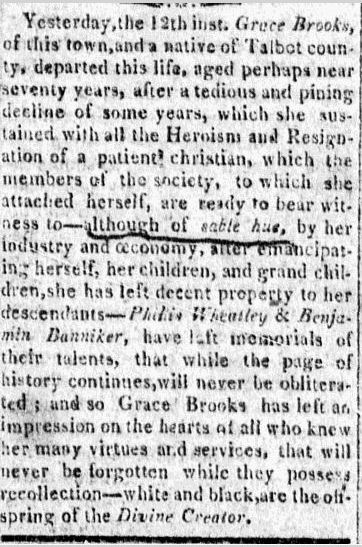
Grace Brooks obituary from the Republican Star newspaper.
In 1740, Grace Brooks was born a slave in Trappe, Maryland. By 1788 she had plied her trade as a midwife for blacks and whites and saved enough money to buy her own freedom and that of a daughter and granddaughter. In 1792 she bought a half acre plot containing a one-story home. The house was less than 300 square feet with a large fireplace and a walnut table with six chairs. Just outside the back door was a chicken coop, well, and trough. The dwelling had three windows and was assessed in 1798 as being worth $50. The home no longer stands on the lot.
As a midwife, Grace Brooks was one of the most trusted and valued members of the community. With a position of such importance she was known by everyone and cared for the entire community, not just her own. She would never realize the impact she had on the town of Easton.
Grace Brooks’ obituary appeared in the Republican Star in 1810. She was the first African American woman to purchase land and the first African American, male or female, to purchase their freedom. The public document (pictured to the left) reveals the important role she played in the Easton community in the late 1700s and early 1800s.
Further Reading
Books
- Hirelings: African American Workers and Free Labor in Early Maryland by Jennifer Hull Dorsey. (Cornell University Press, 2011.)
Web Resources
- Amazing Grace: Deep Histories of Black Freedom in the US
- A 2013 article by Professor Rosemary A. Joyce on her blog Ancient Bodies, Ancient Lives
- Grace Brooks, Our Newest Hero
- A 2013 Talbot Spy article by Kathy Bosin
Sources
This bio was written by General Manager Peggy Morey as part of our 2018 exhibit “The Women of Talbot County.”