
Nathaniel "Nace" Hopkins
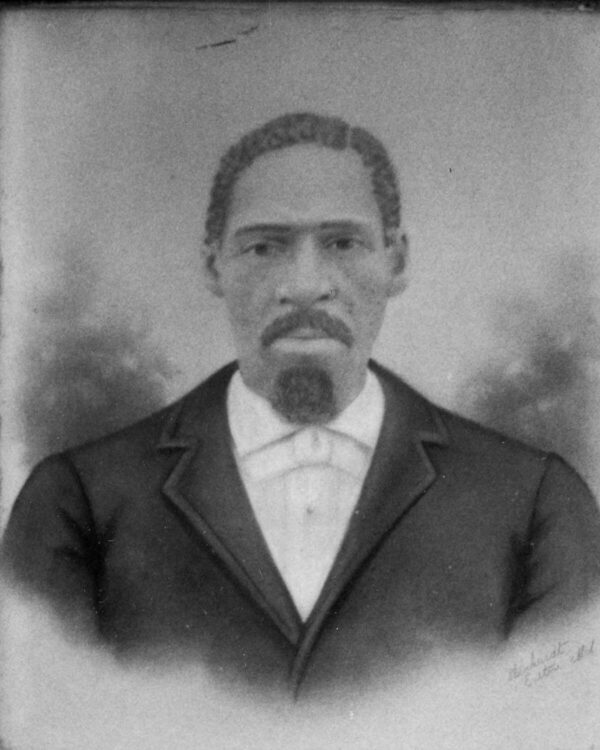
Nathaniel Hopkins, affectionately called “Uncle Nace” in Talbot County, was born a slave circa 1830 in Trappe, Maryland. In 1863, while still a slave, Nathaniel Hopkins enlisted in the Army. He served in the United States Colored Troops of the Union Army during the Civil War. However, in January 1864 his army career ended when he was sent home on sick furlough. Nathaniel Hopkins returned to Trappe to assist newly freed blacks in southern Talbot County, including the 1878 establishment of Trappe’s first black school and later the incorporation of their former “African Church,” which eventually became the Scotts United Methodist Church.
In 1867, Nathaniel “Uncle Nace” Hopkins founded Emancipation Day in Talbot County to commemorate Maryland’s emancipation of its slaves, which occurred November 1, 1864 with the adoption of the new state constitution. This event made Maryland the first state to voluntarily free its slaves by popular vote. This differed from President Lincoln’s Emancipation Proclamation of 1863 which only freed slaves in rebelling states, of which Maryland was not one.
Trappe’s Emancipation Day celebration was held annually with a parade led by Nathaniel “Uncle Nace” Hopkins, and later expanded to include church services, speakers, food, games, music, in addition to the parade. Since Uncle Nace’s death in 1900, Trappe black residents have continued the annual celebration, now known as Uncle Nace’s Day or Nace’s Day. It is the longest continuous public Emancipation Day celebration on Maryland’s Eastern Shore and among the longest in the United States.
Nathaniel “Uncle Nace” Hopkins’s headstone and a historic marker can be found in Trappe, MD. The Nathaniel Nace Hopkins Park is the newest addition to Trappe’s park system. The town was able to acquire the property and remove a deteriorating structure that once stood there thanks to a $200,000 grant from CDBG, along with more than $100,000 in taxpayer funds from the Town of Trappe. The $200,000 grant also required that the land be maintained as open space for a period of seven years. (Information from the town of Trappe website: https://trappemd.net/parks)
Sources:
This biography was written by THS board member Dr. Willie Woods for our African American Room exhibit.
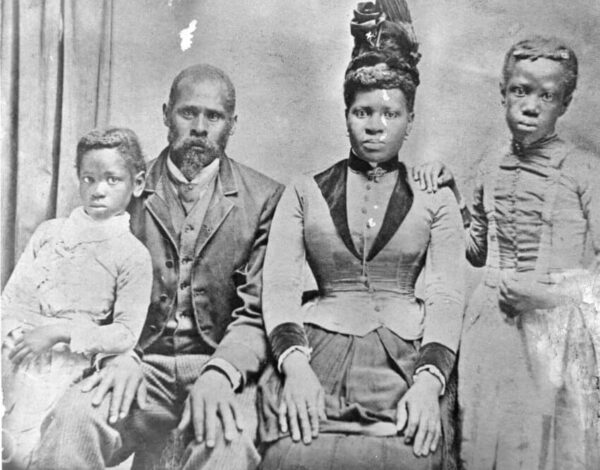
Nathaniel Hopkins, his wife Caroline and his daughters Carrie and Lucretia.
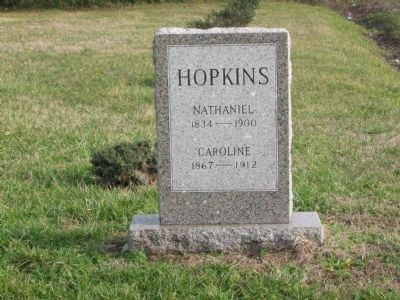
Hopkin’s headstone in northeast corner of intersection of Ocean Gateway (US 50) and Barber Road. Photo from the Historical Marker Database
Further Reading
Books:
- Irregularities in Abundance: An Anecdotal History of Trappe District in Talbot Co., Md. Edited and with Commentary by James Dawson.
- Nathaniel Hopkins: Leader of his People, From Slavery to Present Day by Carol Lange. (2015).
- Trappe: The Story of An Old-Fashioned Town by Dickson Preston. (Easton: Economy Printing Co., 1976), 89-97.
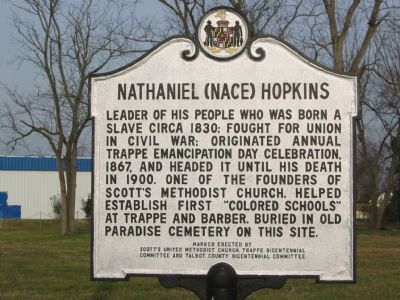
Traditional Maryland historic marker in Trappe, MD on Ocean Gateway (US 50) and Barber Road. Photo from the Historical Marker Database
Web Resources:
- “The soldiering days of Uncle Nace.” – 2016 Star Democrat article by Chris Polk
- “Uncle Nace’s Day: A Shore Tradition for 151 years and Counting.” – 2015 Secrets of the Eastern Shore article
- “War on the Shore: From slave to ‘saint.’” – 2014 Delmarva Now article by Brice Stump
- Nathaniel Hopkins Biography – Part of the Archives of Maryland Biography Series by the Maryland State Archives
- Trappe African-American Heritage and History Gallery – Unicorn Bookshop – This site maintained by historian James Dawson features photos and documents pertaining to African American history in Trappe, including Nace Hopkins.